Water in HTF Systems: Diagnostics & Solutions
Cold starts, pump cavitation, and pressure fluctuations have one thing in common: water. This is your first suspect – always. Here is how to identify and remove it.
1. THE CORE PROBLEM: WATER HIDES ITSELF
Many technicians think: “I’ll just let the pump run and increase the temperature slowly. Then the water will disappear.”
This doesn't work.
Simply heating the liquid without actively removing water only causes water to shift to another spot. It doesn't disappear – it hides:
- In isolation
- Round seals
- In the expansion tank
- In cold corners of the system
The water remains a problem.
2. COLD STARTS & PUMP CAVITATION
The warning signs:
- Pump cavitation (spraying sounds)
- Pressure fluctuations without a clear cause
- Reduced pump flow rate
- Unexplained temperature problems
Cause: Water adsorption in the liquid + gas bubbles = cavitation in the pump.
The solution is not to spin faster – it is to remove water.
3. STANDARD AIR VENTS: USELESS AGAINST WATER
This is a critical misunderstanding.
How normal air vents work:
Many thermal systems have a separate air vent/degasser that separates gases from the liquid. These work well for:
- ✓ Non-condensable gases (air, nitrogen)
But not for:
- ✗ Water vapor (condensable substance)
- ✗ Moisture contamination
- ✗ Moist gases
The reason: Water can condense. Normal air vents cannot remove water vapor – it goes back into the liquid as it cools down.
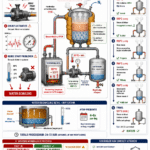
4. THE SOLUTION: BOILING OUT (BLOW-DOWN PROCEDURE)
This is the standard industrial method for water removal. It requires patience and accuracy.
PRINCIPLES OF SUCCESSFUL BOILING:
1. Expansion vessel = Escape route
The vapor must escape into the atmosphere. The only location in the system that can handle this is the expansion vessel. This is where all the water vapor is released from the liquid.
2. Temperature is critical: Keep above 100°C
The key to successful water removal is: ensure that the temperature of the expansion vessel remains ABOVE 100°C.
Why? Any water vapor that cools below 100°C condenses and falls back into the liquid. This prolongs the boiling process exponentially.
Practical tip: Throw insulation blankets over the top of the expansion tank. This keeps the walls of the free space warm and prevents recondensation.
3. Nitrogen clearance helps
Adding a small volume nitrogen play:
- Helps wipe water vapor out of the tank
- Prevents liquid oxidation
- Protects against oxygen accumulation
5. STEP-BY-STEP BOILING PROCEDURE
PREPARATION:
Make sure you open these valves:
- ✓ Heating line – open the valve connecting the heating outlet to the expansion vessel
- ✓ Manual air vent valve – open on the expansion vessel
- ✓ Operating and shut-off valves – open on every loop (miss one and you've done it all for nothing)
- ✓ Overflow tank – ensure it is empty
Tip: If your heating system does not have a heating pipe – install one. This is essential for efficient boiling.
COOK-OUT STEP-BY-STEP PLAN:
Step 1: Start temperature
- Slowly raise the heating temperature to 107°C
- Check for steam (visible from expansion vessel) and pump noise
- Allow to stabilize
Step 2: Incremental increase
- Increase heating temperature by +3°C
- Check again for steam and strange noises
- Let this stabilize for 10-15 minutes
- Repeat these 3°C steps
Step 3: Critical temperature range.
Repeat step 2 until the system is stable with a pump suction temperature of 121°C.
Warning: It is the pump suction temperature that is most important – NOT the heater outlet. Monitor this continuously.
Step 4: Final check
- Steam must become less visible
- Pump noise should be normal
- Pressures must remain stable
- This can 48-72 hours , depending on moisture load.
6. WATER COLLECTION: DRAINAGE & MONITORING
Thermal buffer tank (if present):
Many systems with air vents have a thermal buffer tank that prevents hot liquid from entering the expansion vessel directly.
Water collection: During boiling, water collects in this tank.
Criticism: If this tank does not have a drain valve at the very bottom – install one. You must drain this water regularly.
7. SAFETY POINTS OF ATTENTION
⚠️ This process must take place under supervision:
- Don't work alone
- Ensure adequate ventilation
- Personal protective equipment (heat-resistant gloves, safety glasses)
- Keep a constant eye on pressures and temperatures
- Have emergency procedures ready (slide, leakage)
- Do NOT leave the system unattended at high temperature
8. AFTER BOILING: RESET SYSTEM
Before you put the system back into normal operation:
✓ Close the heating line
✓ Close the manual air vent valve
✓ Check all drain points (no residual water)
✓ Perform moisture measurement (Karl Fischer test)
✓ Allow the system to cool to operating temperature
✓ Monitor pressures and temperatures for 24 hours
9. CHECKLIST: WATER REMOVAL
DIAGNOSIS:
- ✓ Test on water – Karl Fischer titration
- ✓ Visual inspection – darkening/cloudiness?
- ✓ Pump cavitation present?
- ✓ Pressure fluctuations measured?
PREPARATION BOILING:
- ✓ Warm-up pipe opened
- ✓ Vent valve opened
- ✓ All loop valves open
- ✓ Overflow tank empty
- ✓ Insulation blankets for expansion tank ready
- ✓ Nitrogen available
- ✓ Thermometers installed (especially pump suction)
DURING BOILING:
- ✓ Starts at 107°C
- ✓ Steam visible from expansion vessel?
- ✓ Pump noise normal?
- ✓ Temperature incremental (+3°C steps)
- ✓ Monitor pump suction temperature (target: 121°C)
- ✓ Water is drawn from buffer tank
- ✓ Steam diminishes after 24-72 hours
AFTER BOILING:
- ✓ Heating line closed
- ✓ Vent valve closed
- ✓ Moisture measurement performed
- ✓ Value <200 ppm (ideal <100 ppm)
- ✓ System back to normal operation
10. PREVENTION: PREVENT WATER
Once solved, ensure that water does not return:
- Breathers with inert gas protection (nitrogen)
- Expansion vessel maintenance (regular drying)
- Regular fluid analysis (annual)
- Tight seals (no leakage, no infiltration)
- Protected insulation (moisture-resistant material)
- Cleaned systems remain closed (no air/moisture ingress)
WARNING
Many sustainability problems of thermal systems – especially cold starts, cavitation, and pressure fluctuations – are water-related. This is often missed because it is invisible.
Forget the standard air vent. Water removal required:
- Active dehydration by boiling
- Proper temperature control
- Patient monitoring
- Preventive maintenance
NEED ADVICE?
This process requires expertise and caution. Do you have questions about water in your system, or would you like support with boiling it out?
Contact our HTF specialists:
📞 Call: +31610275211
📧 Email: [email protected]
📋 Or: Request advice directly
We help you get the water out – and prevent it from coming back.