

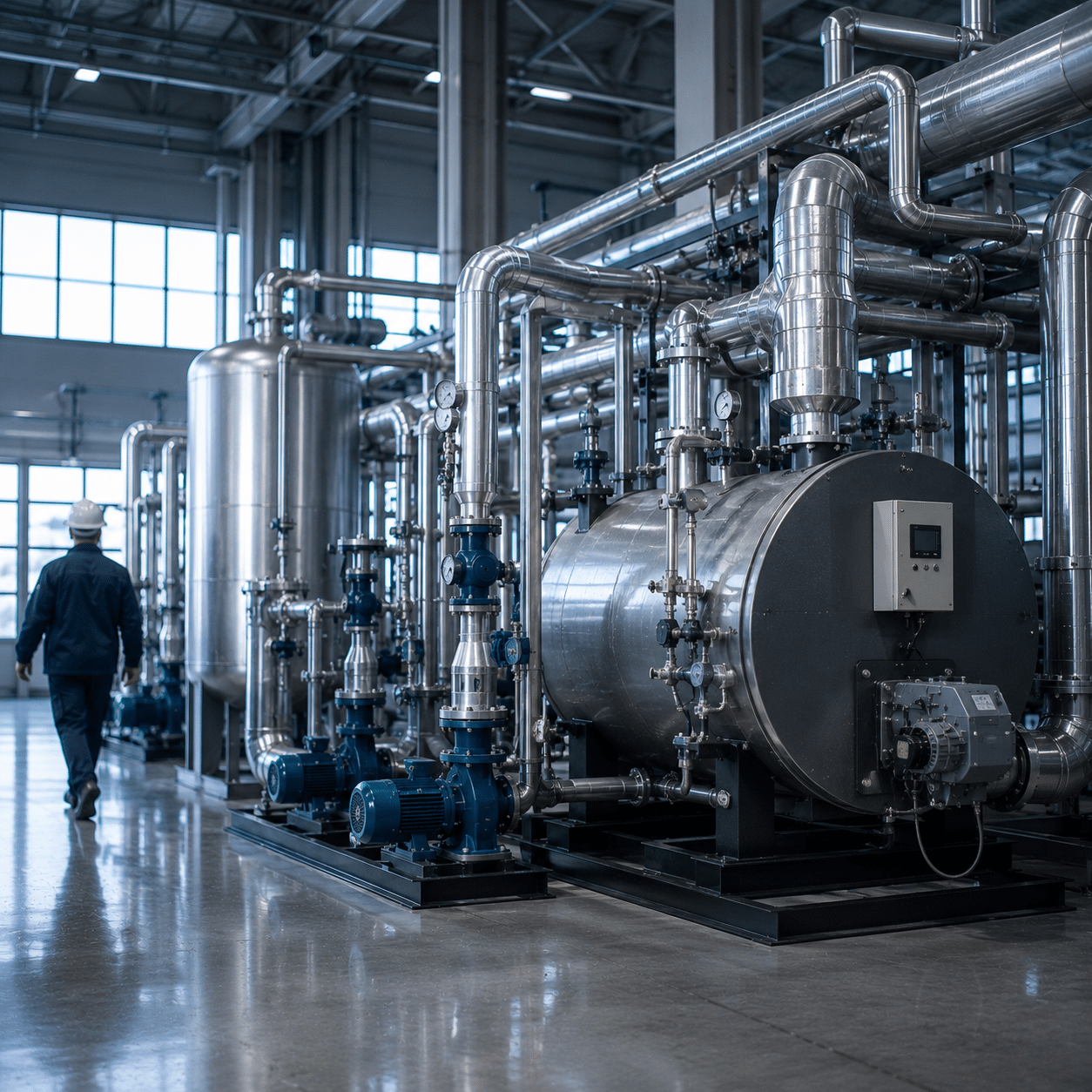
The primary system consists of a boiler, pump(s), piping, storage tank, expansion tank, possibly a heat exchanger, etc., which is installed as a circuit, naturally equipped with the necessary pressure and temperature protection units. The boiler heats the thermal oil, and the pump circulates the oil in the primary circuit.
Thermal oil systems can be equipped with so-called economizers. These are units installed in the boiler's exhaust gas system that can improve efficiency by a few percent.
In the secondary circuits—those parts of the thermal system connected to the users (this could be a reactor vessel, a drying tunnel, or whatever)—the required heat will be released via controlled valves. The cooled oil is pumped back into the primary circuit to be reheated by the boiler.
It should be clear that the capacity of the heating boiler depends on the size of the secondary circuits and the required heat per circuit. In thermal oil systems, all circuits are protected against overpressure, excessive and/or low temperatures, and the flow is constantly monitored. In the event of pump failure, the boiler is automatically switched off to prevent overheating and/or combustion of the thermal oil.
By far the majority of thermal oil systems up to 350°C are virtually pressureless and operate in the liquid phase of the thermal oil. At temperatures above 350°C, the pressure can rise to as much as 10 bar. Thermal oil systems operating around 400°C can operate in the gas phase of the thermal fluid as well as the liquid phase, depending on the customer's requirements.
A complete and growing product portfolio